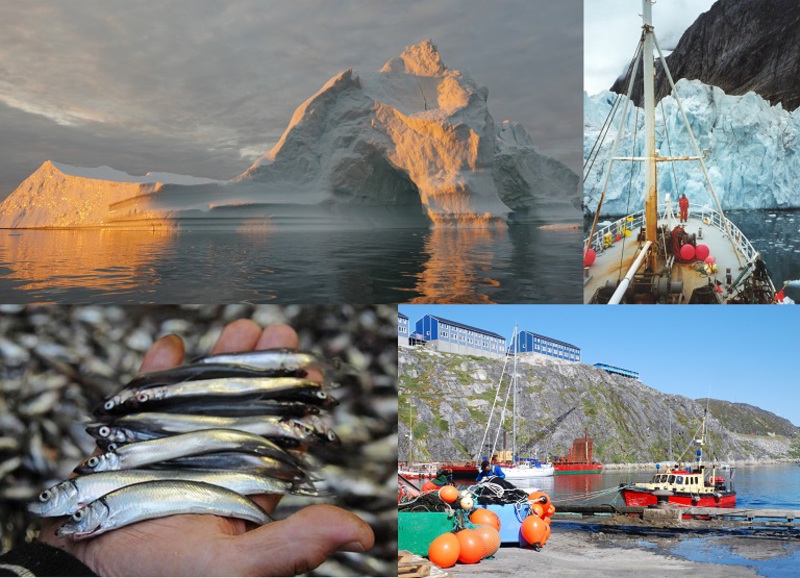
The ocean area of East Greenland lies at the intersection of the Arctic Ocean and the Atlantic Ocean — between cold and temperate bodies of water. Here we find an ecosystem that is slightly different a second ecosystem such as e.g. The North Sea and the Barents Sea. The ocean area lies at the intersection of cold and warm bodies of water and is rapidly affected by climatic changes. It is not as affected by commercial exploitation as many other areas in the North Atlantic. This makes the area particularly interesting to research. One may therefore ask whether the knowledge the researchers uncover is more likely to be related to natural changes than to the taxation of resources.
Collecting and sharing provides insight
East Greenland is an area for international fisheries in which Norway is a key player. Norway and Greenland have been negotiating fishing quotas for these waters since 1991. Cooperation has been established that also includes research and knowledge acquisition to ensure sustainable fisheries management.

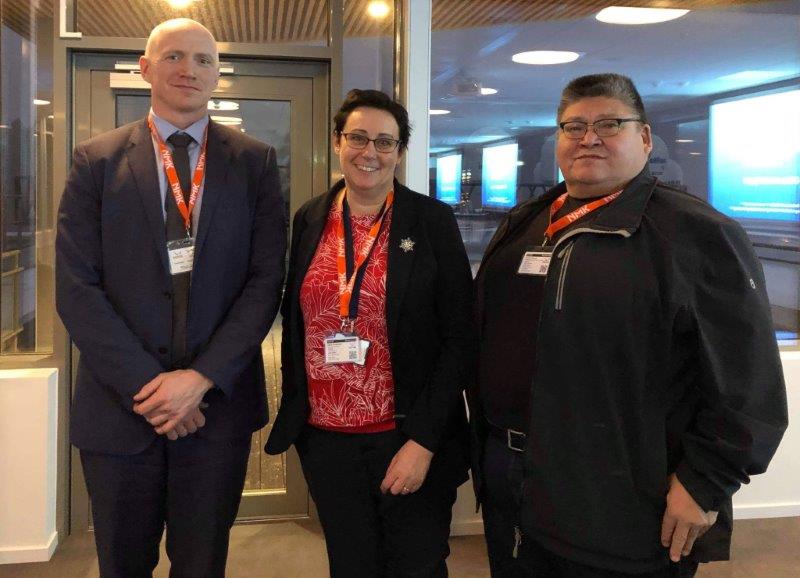
The research project called CLIMA has brought together expertise from six research institutes in four countries. Since the end of 2015, they have collaborated to gather and share knowledge in order to gain greater insight into the ecosystem of the marine areas of East Greenland. The work has been funded by the Norwegian Ministry of Foreign Affairs together with the own efforts of all partners. The project has been led by Møre Research. This week, Møre Research welcomed its research partners to a meeting and closing conference in Ålesund.
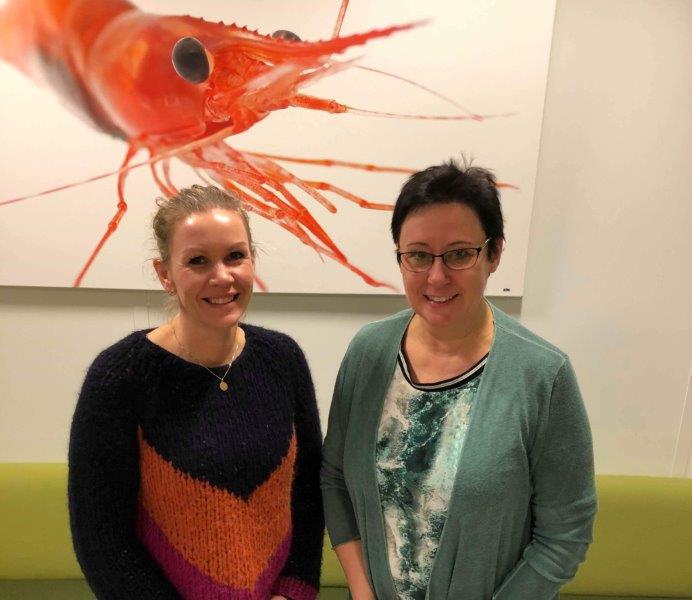
- The Climate project creates new possibilities for understanding what is happening in one of the important ecosystems of the North Atlantic. An ecosystem that is directly affected both by the strong polar current from the Arctic and the warm Atlantic Current (Irminger Current), explains Agnes Gundersen, Project Manager and Director at Møreforsking AS.
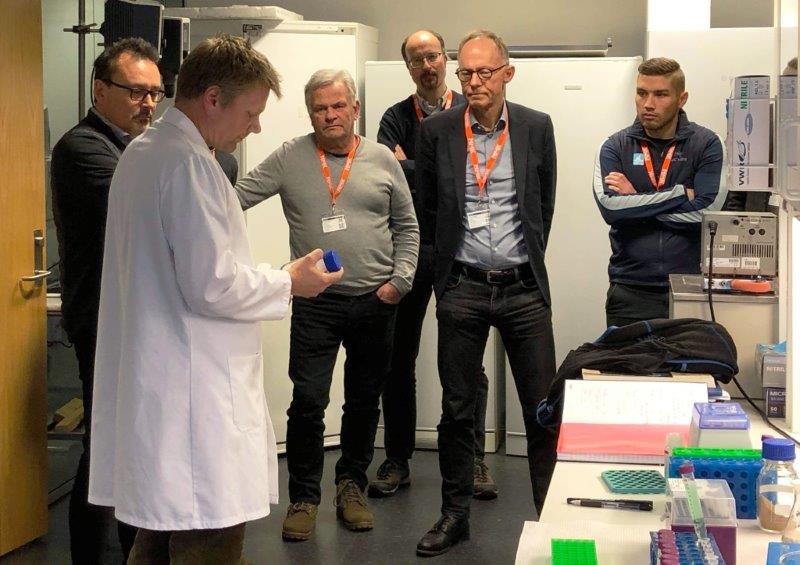
Until now, the Clima project scientists have, among other things, examined demersal fish communities and conducted stomach analyses of cod to see what they eat. They have also looked at population dynamics in fish and how this is affected by fisheries. Furthermore, they have obtained a historical record of fishery activity in the important commercial fishing fields of West and East Greenland.- By combining data material from several nations and research communities, we can see trends and implications that we do not arrive at with the datasets individually. It also provides a common understanding of what is now happening in the ocean. Insights become an important foundation for sustainable management of our resources, comments the project manager.
Higher sea temperatures have consequences
Water temperatures in eastern Greenland have risen in recent years. An important part of the project has been to collect the data available on the climate variables in the area. This work has been done by the German partner Thünen Institute. When these data are combined with fishing-related information, larger lines can be drawn. - We have found, among other things, that species richness has decreased and that the total abundance of fish has decreased since 1998, says Møre researcher and doctoral fellow Margrete Emblem. “This happens at the same time that the bottom temperature has increased by about 0.5°C on the continental slope between 400 and 1500m, where the main fish banks are located. The most likely driver of the temperature changes is increasingly warmer inflows of Atlantic water (the Irminger Current). We also see that there is a change in community structure specifically in the deeper parts of the study area (600-900m). It indicates that something other than a general increase in temperature must have changed in the environment causing this. This is something we are working on now,” Emblemsvåg explains.
- We look at variables such as changes in ice cover and primary production (production of organic matter) that can lead to major changes in the food web.
Opposite changes than in the Barents Sea
As water temperatures rise, an influx of species is expected to pull northward as a result of new ocean areas and habitat opening up, and/or species seeking colder waters where they are adapted.
- This leads to a general increase in the number of species in northern waters as we now see in the Barents Sea, says Emblemsvåg.
- In the sea areas of eastern Greenland, on the other hand, we see the opposite. The number of species is decreasing. This is possibly caused by the topography and flow directions of the area which place restrictions on both immigration and emigration of species. Another explanation could be that deep-sea species are generally less mobile and have a “slower” response than shallower and pelagic species. This makes them unable to adapt quickly enough when the environment changes.
The warning lights are on
In summary, we can say that the water temperature is increasing, even in the deeper ocean areas. The number of species and the total amount of fish are decreasing and there is a change in species composition and interaction between species in the depths. Great species richness in an area creates a buffer against climate variation, overtaxation and potential collapse in fisheries and in ecosystem. If species diversity decreases, more unstable ecosystems can be expected. If the observed ecological trends continue, it is likely that the ecosystem of eastern Greenland will become more vulnerable, the Climate scientists conclude.
Larger changes in the food chain will also have consequences for individual species. Therefore, in order to achieve sustainable management, the authorities managing the marine areas must take into account the changes taking place at the ecosystem level. In the opposite case, improper taxation of species in an ecosystem already “stressed” by environmental changes may cause the overall overall pressure on the ecosystem to be too great. The ecosystem can be displaced. Which species will disappear? The researchers seek to find answers to this in their further work.
International cooperation has provided more insight
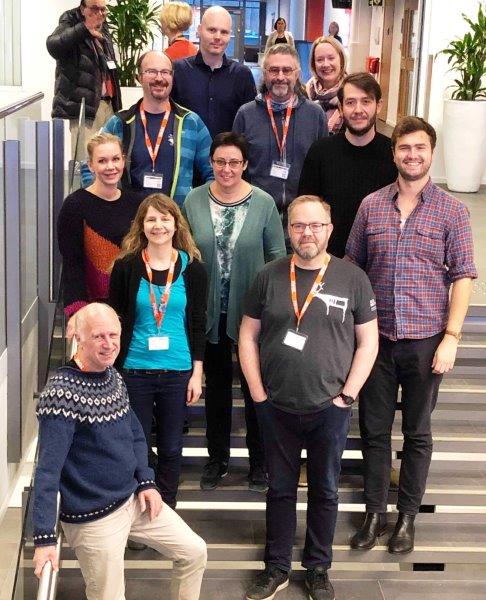
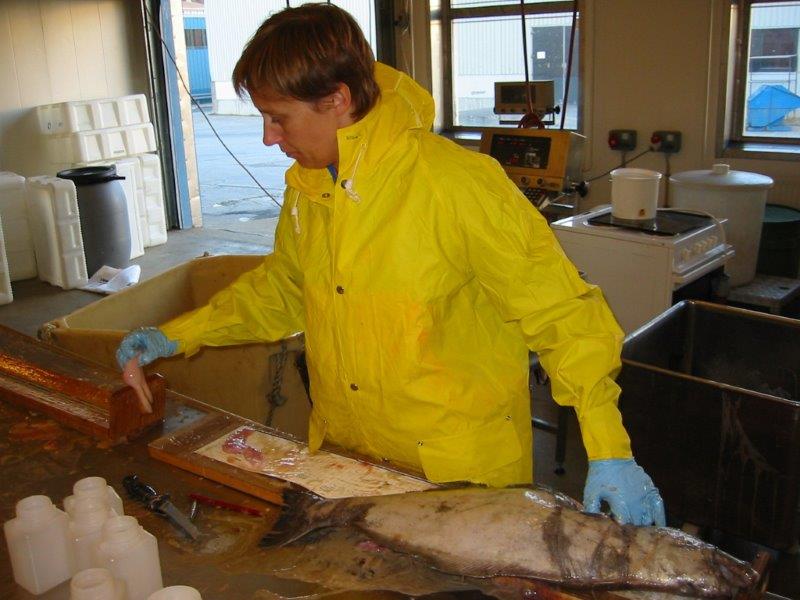
The CLIMATE project has been a collaboration between the Greenland Institute of Nature, the Thunen Institute of Sea Fisheries in Germany, the Marine and Freshwater Research Institute in Norway, the Marine and Freshwater Research Institute in Iceland (UiT), the Arctic University of Norway (UiT), and Møre Forsking in Ålesund.
“This has been a solid and fruitful collaboration,” says project manager Agnes Gundersen, Director of Møre Research.
- These are partners who have worked on various projects together since the early 1990s. It's reassuring to have so much solid expertise with the team.
Gundersen has been a project manager, and has extensive experience in fisheries and research on the fish deposits around Greenland.
- Cross-border cooperation is a prerequisite for sustainably harvesting our resources and understanding what climate variation can bring about consequences for our fish stocks, comments Project Manager Gundersen.- As you know — there are no limits underwater, she comments with a twinkle in her eye. And the insight obliges.
Should affect the taxation of fish stocks
The bilateral negotiations between Norway and Greenland on fishing quotas were held in Ålesund in connection with the Climate Conference. Head of the Norwegian delegation to the negotiations Kristoffer Krohg Bjørklund from the Ministry of Industry and Fisheries takes the findings of the Climate project very seriously.
- It is very important that we follow these changes closely in the future, so that we are careful to harmonize the taxation of fish with the evolution of the ecosystem. We have an important responsibility to maintain a sustainable fishery also for the future,” he stresses.