The ecology of the North Atlantic is constantly changing. However, sometimes the changes occur abruptly. A key driving force behind such sudden changes are so-called extreme events, such as marine heatwaves. A research team has now discovered that a single, large-scale heatwave is still affecting ecosystems and trophic interactions in the subpolar North Atlantic today. The study is now published in the journal Science Advances.
Such an event also affects us humans, because it changes the distribution of fish species we have been adapted to catch and consume for decades. Marine heatwaves can have sudden and unpredictable effects on marine life. One of the questions raised in the study is under what conditions such heatwaves can develop.
“We found that more marine heatwaves occurred after 2003, but none of them had the same effect as the one in 2003,” Emblemsvåg says.
A “perfect storm” that lasts to this day
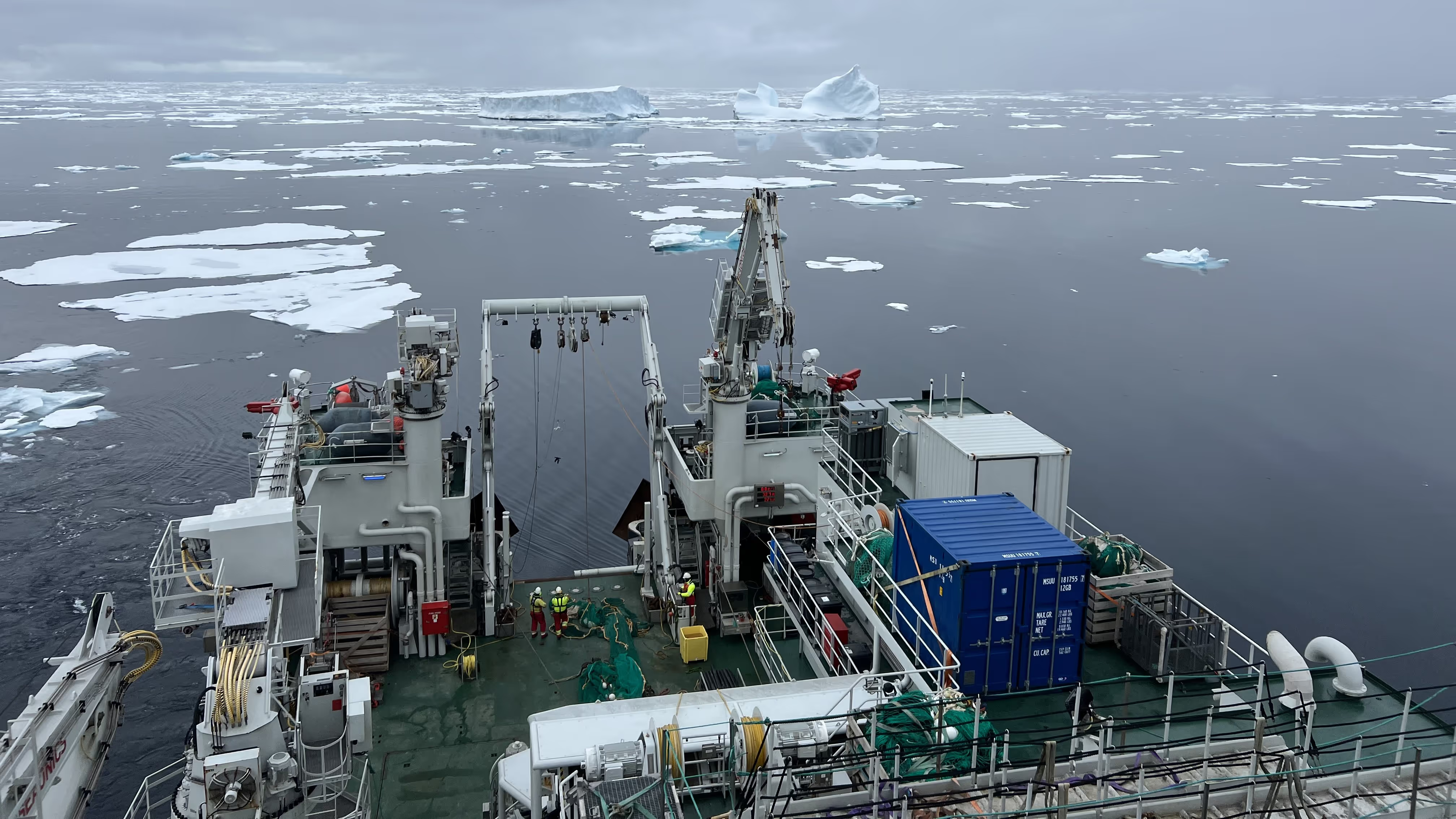
The researchers investigated how a large-scale physical extreme event affected the distribution of organisms and species communities in the ocean. To this end, they analyzed around 100 biological time series taken from different areas of the North Atlantic. Important data came from, among others, the LTER Observatory (Long-Term Ecological Research) HAUSGARTEN at the Alfred Wegener Institute, the Helmholtz Centre for Polar and Ocean Research (AWI) in Bremerhaven. Here, in the Fram Strait between Svalbard and Greenland, long-term ecological data have been collected for 25 years. A majority of the parameters examined showed abrupt changes in 2003 or soon after.
In 2003, a so-called “perfect storm” occurred in and over the subpolar North Atlantic. A “perfect storm” describes a combination of events that together have dramatic and often unpredictable consequences. Unusually low amounts of Arctic water flowed south along the east coast of Greenland, while unusually large amounts of warm, subtropical water flowed into the North Atlantic between Iceland and Scotland. The atmospheric temperatures over the North Atlantic also reached record high values in 2003.
The effects hit Europe, where thousands died as a result of atmospheric heatwaves. The combination of atmospheric and hydrographic events led to record high water temperatures in the ocean areas from the Norwegian coast to West Greenland, thus encompassing the entire subpolar North Atlantic. From single-celled algae to cetaceans—all levels of the ecosystem were affected by the unexpected heat.
Far-reaching consequences
Capelin, a cold-water species, quickly ran into trouble, while heat-loving species such as cod and haddock extended their ranges northward. Capelin are the main prey fish for other species in the subpolar North Atlantic, and thus a key species in the ecosystem. As a result of the temperature changes, it moved its spawning grounds northwards from southwestern Iceland. This had far-reaching consequences: Eggs and larvae began to drift towards less favorable habitats near the east coast of Greenland, where the probability of survival is lower.
Other species, on the other hand, appear to be benefiting from the changes. Humpback whales follow capelin and are now observed far more frequently in Southeast Greenland than has been common in the past. Although the Fram Strait, the passage between Svalbard and Greenland, is thousands of kilometres from the starting point of the marine heatwave, scientists were able to link a warm water anomaly in the Fram Strait to the heatwave about two years after its origin.
The warm water moved north, carrying new organisms to the Fram Strait. At the same time, due to an increase in temperature, there was an increase in primary production and a shift from fat-rich Arctic zooplankton to more low-fat Atlantic zooplankton adapted to warmer bodies of water. This led to an abrupt upheaval of the entire ecosystem—from the ocean surface to the deep ocean floor. Remnants of the increased production in the surface eventually sank to the ocean floor and fed organisms living on and in the sediments, such as brittle stars and nematodes that increased in number. The process by which Arctic communities are increasingly being replaced by more temperate Atlantic ones is referred to as borealization.
Our results show that unexpected extreme events can lead to unpredictable ecological cascades. How rising temperatures will affect marine biodiversity, however, is very difficult to predict.
“We can say something about how rising temperatures affect the metabolism of organisms—and thus which areas of distribution are suitable or unsuitable. But a species' success also depends on factors such as access to food and the presence of predators. This gives a complex picture.”
The species likely to benefit most from increased temperatures in the subpolar North Atlantic are opportunistic generalists such as Atlantic cod. It spreads and pray on what it can find, if the conditions are right.
Local warming will cause extreme events to occur more frequently than in the past and become a key driver behind climate-induced changes in ecosystems. Such events are complex and difficult to predict with current climate models. This underscores the need for empirical studies of ecosystem response to extreme climate episodes.
Original article:
Werner, K. M., Núñez-Riboni, I., Soltwedel, T., Primicerio, R., & Emblemsvåg, M. (2026). Major heat wave in the North Atlantic had widespread and lasting impacts on marine life. Science Advances,! 12(1), eadt7125. https://doi.org/doi:10.1126/sciadv.adt7125
More about this project
The RESOLVE project explores how nature-based solutions (NBS) can reduce cumulative risks to biodiversity under climate change, with a focus on high-latitude regions like the Arctic and subarctic.